
The One Question That Actually Matters
For most of the last two years, the question inside financial institutions has been can AI do this. That question is largely settled now. The one that actually matters — the one shaping how money moves, how credit gets priced, how compliance gets proven — is who’s allowed to act, under what limits, with what evidence trail, and at what cost.
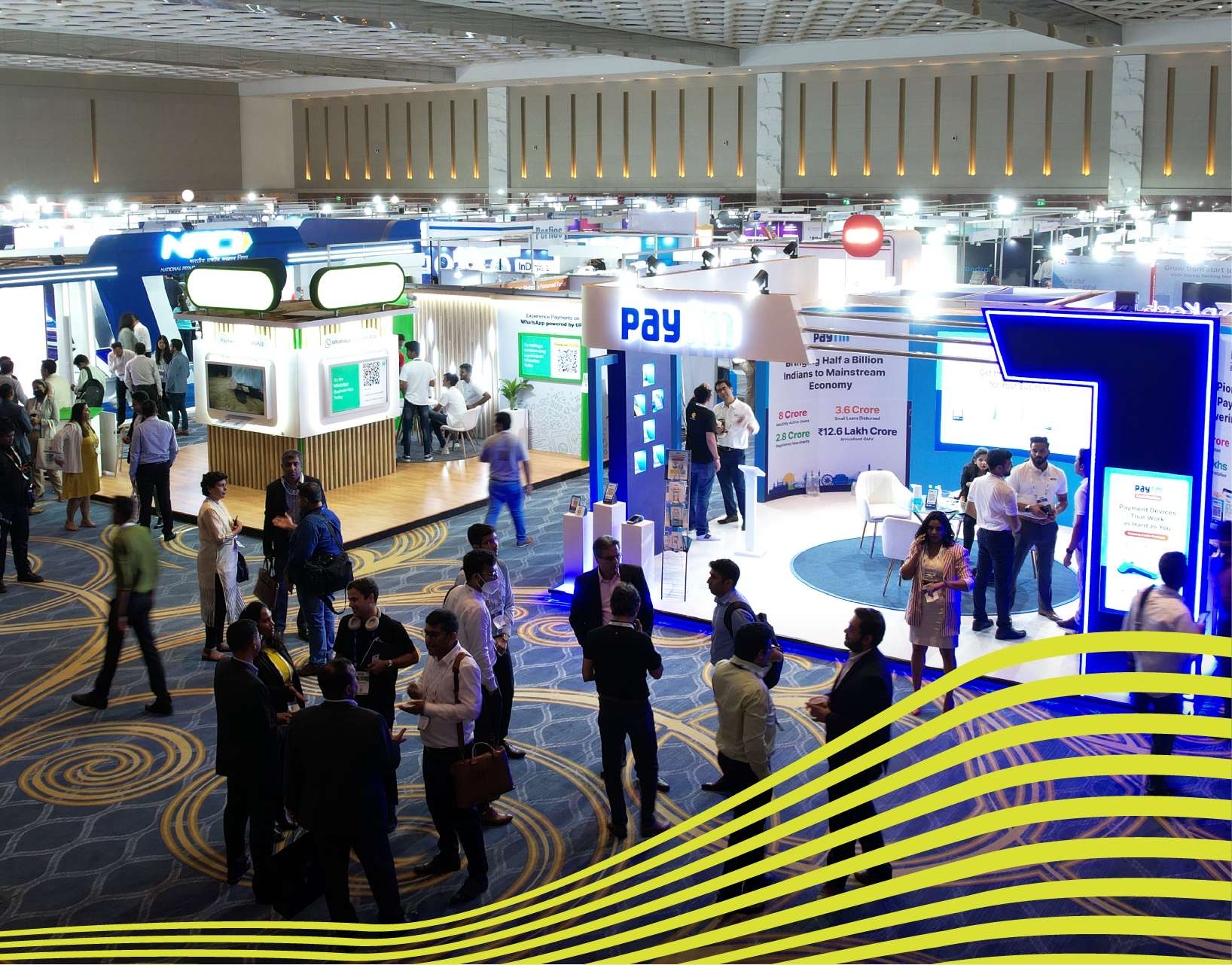
Four of our leaders arrived at some version of that same conclusion this year, independently, from four different seats in the business. One of the settings that sharpened the thinking was a recent industry gathering in Mumbai on BFSI and agentic systems. What follows isn’t a recap of that event — it’s the thinking it helped bring into focus.
AI got permission this year. It hasn’t earned accountability yet.
Sriram Jeyabharathi, Chief Product & Technology Officer
The development that mattered most this year wasn’t a new model. It was a new boundary. Agentic payment flows are now live in production in India, inside defined limits, across several major consumer and payments platforms. The interesting part isn’t that AI can now initiate a payment — it’s that the network operator has drawn a hard line around it: AI can recommend a transaction, it can’t approve one on its own. That’s not “regulation will catch up eventually.” That’s regulation showing up inside the rail itself, ahead of where most institutions’ own governance thinking currently sits.
I’d put it plainly: authority is being separated from intelligence at the infrastructure level, deliberately, faster than most individual banks and NBFCs are building the internal muscle to do the same. Institutions still treating “the model is accurate” as the finish line are going to find themselves retrofitting governance under regulatory pressure, instead of designing it in from the start.
You can see the gap in the vendor market too. Everyone ships “guardrails” as a bullet point on a slide. Almost nobody treats assurance — a continuously auditable record of what the system did, why, and inside what limits — as the actual product. That’s the open lane, and no foundation model closes it for you. It gets closed with domain depth, applied one regulated workflow at a time, with the audit trail built in from day one rather than added before a compliance review.
The economics make this concrete rather than abstract. It still costs an institution close to ₹150 to originate a ₹10,000 loan — a hard ceiling on how far down-market small-ticket lending can go profitably. A routine loan application can still take seven separate OTP verifications to close. Neither number moves because a chatbot got bolted onto the front end. Both move only when AI gets applied to the actual friction — identity checks, document processing, decisioning speed — not layered over the top of it.
My read on where this goes: platforms trying to cover every BFSI use case with one AI layer are underestimating how differently “governed” gets defined and audited across fraud, lending, and onboarding. Depth in one workflow, provably bounded, beats breadth across five unproven ones. No institution has a budget line for “AI governance.” Every institution has one for the use case that governance makes deployable.
“AI-native” stopped meaning anything the moment everyone claimed it.
Sridhar Karra, Chief Operating Officer
Here’s the pattern that stood out to me this year, and it wasn’t any single vendor’s product — it was how identical the pitches had all started to sound. Strip the branding off a dozen booths at almost any fintech event and the language collapses into the same four or five words: agentic, intelligent, autonomous, next-gen. When every competitor uses the same vocabulary, that vocabulary stops carrying any information for the buyer. It just becomes noise with a logo on it.
The companies that actually held my attention did something narrower instead. One services firm I spoke with pitches its delivery model by leading with the customer’s own outcome — the subscription tooling, the guided training, the build-operate-transfer engagement — and lets the AI sit underneath that story rather than in front of it. Another built one integration point that lets an entire ecosystem plug in — insurers, brokers, banks, NBFCs — without each partner rebuilding their own stack. Neither one opens with “we do AI.” Both open with something a buyer’s own board already has a line item for.
That’s the distinction I keep coming back to: selling AI is a technology conversation. Selling an outcome is a procurement conversation. Only one of those ends in a purchase order.
So that’s the bar for us. We stop leading with “we do agentic AI” — a phrase so overused it now tells a sophisticated buyer almost nothing — and lead instead with the specific problem we solve, the domain expertise that makes us credible in that problem, and a delivery record that holds up on a reference call. It’s a smaller, less flashy story to tell in a booth. It’s also the only one that still sounds true a year after the pilot ends.
The market is converging on a handful of trusted infrastructure layers — not splitting into a thousand platforms.
Murali K Muddada, Head, IT Automation & Modernization
Three things I saw this year, each in a different layer of the stack, all point the same direction. National payments infrastructure is open-sourcing parts of its own technology instead of guarding it. Sovereign language model efforts are building India-specific foundation models instead of defaulting to imported ones — a deliberate call about who controls the data and the model’s behavior, not just a technical preference. And shared technology stacks are being built for entire networks of cooperative and regional banks — over a thousand institutions at once — instead of being sold bank by bank, RFP by RFP.
Looked at separately, those are three unrelated infrastructure stories. Looked at together, they describe consolidation, not fragmentation: the market is settling around a small number of shared, trusted layers — identity, payments, model access, regulatory data — rather than splintering into an ever-growing pile of point solutions all competing for the same budget line.
That cuts against the usual platform-business instinct, which is to build wide and sell everywhere. In this market, breadth extends your sales cycle. Depth shortens it. The institutions actually buying right now want a partner who owns one function completely — onboarding, fraud, compliance monitoring, credit decisioning — end to end, and who plugs cleanly into the shared infrastructure layer instead of trying to replace it. Digital identity, payments modernization, and decision intelligence are stopping being three separate markets with three separate sales pitches. They’re becoming one connected layer, deployed in modular pieces rather than sold as one giant platform. The vendors who build for that — composable, integration-first — are going to out-execute the ones still pitching a do-everything platform into a market that’s already decided it wants the opposite.
The edge isn’t a smarter model. It’s what the model is allowed to touch, and how well you can prove it.
Yeshwanth Hegde, Head, Infrastructure Automation
Two things caught my attention this year, in completely different corners of financial services, and they turned out to be the same idea wearing different clothes: regulatory compliance, and physical collateral verification. Both push AI into territory where the real constraint was never intelligence — it was trust in the underlying source of truth, and being able to prove that trust to someone else.
Start with compliance. There’s decent tooling already for standardized frameworks — ISO 27001, PCI-DSS. The harder, messier problem is the constant churn of India-specific regulatory change: RBI and SEBI circulars, master directions, gazette notifications, each one requiring an institution to go back and re-check its own controls and policies against text that changed last week. Smaller and mid-sized institutions, in particular, don’t have the bandwidth to do this continuously — most still catch up at the next scheduled audit instead of the day the notification drops. What’s emerging isn’t a chatbot bolted onto regulatory PDFs. It’s a real-time reconciliation between what changed and what the institution actually does, with citations an auditor can independently check.
Then there’s physical collateral. Rural and semi-urban lending in India still runs heavily on livestock as security, and the verification infrastructure behind it — ear tags, physical branding, paper registers — hasn’t meaningfully changed in decades, and it’s easy to game. The same animal can end up pledged against more than one loan, or insured more than once, across institutions with no shared record between them. Biometric identification originally built for people is now being credibly extended to animals — unique ID through facial and structural pattern recognition — closing a fraud gap that’s been sitting there, largely unaddressed, for as long as collateral-backed agricultural lending has existed. And it’s not just an India problem — anywhere livestock functions as bankable collateral, the same gap exists.
What connects both: in neither case is AI’s value about producing an answer. It’s about establishing a chain of custody someone else can trust without redoing the work themselves — from regulation to control, from animal to owner to loan. That’s a genuinely different pitch than “our AI is smarter.” And it’s harder to compete away, because it’s built on domain trust, not model performance.
The convergence
Arun Tanksali, Chief Executive Officer
Four leaders, four different parts of the business, and one conclusion none of them coordinated on beforehand: the market doesn’t need another company that “does AI.” It needs partners willing to be judged against three specific things — what expensive problem this actually solves, what auditable trail proves the system stayed inside its limits, and whether the unit economics genuinely moved or the interface just got friendlier.
That’s a narrower claim than most of what’s being pitched right now, and a harder one to stand behind. It’s also the only version of it that survives contact with a regulator, an auditor, or a CFO asking for the return a year after the pilot quietly wound down. That’s the bar we’re building against.